
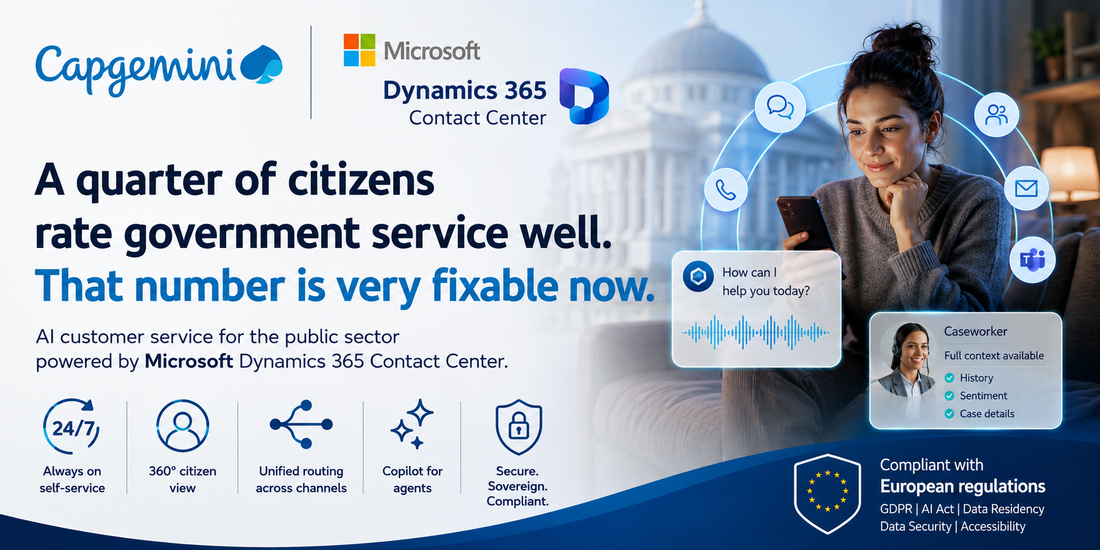
Capgemini's research puts citizen satisfaction with government customer service at 25%, last of every sector we surveyed. Low, but I read it as an opening. The tools to move that number are finally good enough, and for public sector AI customer service, Microsoft Dynamics 365 Contact Center is a platform I would happily put in front of a regulator.
The full paper is here.
Let me show you what I mean.
A parent loses their job and, at eleven at night, messages the local government service from the sofa. A voice or chat agent walks them through unemployment support and free school meals there and then. Next morning a caseworker rings, already up to speed, and they sort out a plan together. Inside a week a few different agencies are helping, and the parent explained their situation once. That story comes straight from the Capgemini paper, and none of it needs inventing. It runs on features that already ship in Dynamics 365 Contact Center.
What the platform actually gives you
The parent gets help at eleven at night because Copilot Studio voice and chat agents handle self-service around the clock. The conversation feels human because the new real-time voice agents cope with interruptions and topic changes instead of forcing people down a phone menu. When the case needs a person, the agent hands off with the full context attached, so nobody starts from scratch.
The caseworker picks up already briefed because Dynamics pulls history, sentiment and case data into one view. And the parent avoids the usual runaround because unified routing sends each request to the right person across voice, chat, SMS, Teams, social and email.
The fuller picture, feature by feature:
- Round-the-clock self-service: Copilot Studio agents and conversational IVR
- Voice calls that feel like conversations instead of menus: real-time, low-latency voice agents
- One profile per person, so nobody repeats their story: the 360-degree view with history, sentiment, topics and case data
- Requests reaching the right person first time: unified routing across every channel
- Faster frontline work: Copilot summaries, suggested responses and knowledge chat
- Services that reach people who need support: multilingual agents, mid-call language switching and live transcription
- Supervisors steering in real time: session insight and sentiment dashboards
If you are starting out, put Copilot next to your agents first. Summaries and suggested responses carry low risk, deploy quickly, and staff feel the difference in the first week. Scale into self-service voice once your data holds up. That is exactly the sequence the paper recommends: start small, measure, grow.
The European rules, and why they are less scary than they look
Public sector leaders ask about the rules before the features, and they are right to. Microsoft has put a lot of work into this, so the platform meets European requirements by design.
Your data stays in Europe. The EU Data Boundary is a firm commitment across Dynamics 365, Power Platform and Copilot, keeping content and AI processing inside European datacenters by default. If a service needs more than that, the sovereignty options step up: Sovereign Public Cloud, Azure Local, disconnected deployments, and Data Guardian, which keeps data access with Microsoft staff based in Europe. You pick the tier that suits the sensitivity.
On the AI Act, the headline duty for a contact center is already in force as of August 2026: tell people when they are talking to AI. You configure that disclosure in Copilot Studio, on voice and chat, and the conversation gets logged. The heavier high-risk obligations, the ones around benefit eligibility and essential services, were pushed to December 2027 under the Digital Omnibus, so you have runway. GDPR sits underneath all of it, and Purview gives you the governance layer for retention, PII and the rest.
So the foundation is solid. The work is in setting it up correctly for your specific service, and that is the part we do with clients every week.
Where we come in
A capable platform still needs the right hands to make it defensible. My team's job is to turn Dynamics 365 Contact Center into a solution that stands up to your regulator and delivers the experience the paper describes.
- AI Act readiness: we classify your use cases, run the DPIA, and set the human-in-the-loop points
- Data sovereignty: we match each service to the right Microsoft tier and set up the tenant and processing correctly
- Accessibility: we build multilingual, transcribed, plain-language experiences that meet public sector obligations
- Life-events design: we shape routing and the citizen profile around real moments, not your org chart
- Adoption: we train staff and supervisors, and set the hybrid-team KPIs that show it is working
We pair Dynamics 365 and Copilot Studio engineering with public sector delivery and European data governance. That combination is what gets you from a promising demo to a service people trust.
The 25% is where the sector starts, not where it stays. The technology to give people fast, accessible, personal service is here, it runs on a foundation Microsoft built for European rules, and you can move quickly without cutting compliance corners.
If you want to work out what this looks like for your organization, get in touch.
Read Capgemini's paper: Could AI be the key to great customer service in the public sector?
Platform detail sits here
Peter Ruiter is Principal Solution Architect at Capgemini, global Contact Center lead, and CTO for Microsoft Dynamics 365 and Microsoft CX in the Netherlands.
Comments